A geothermal system draws its heat from the ground rather than the air. Below about six metres, the ground in Quebec holds roughly 8 to 10 °C all year, warmer than the winter air above it and cooler than the summer air, and it stays there no matter what the weather does. That is why a geothermal unit holds a coefficient of performance of about 3 to 4 straight through the winter, while an air-source machine has to work harder as the temperature drops. Our article on how geothermal heat pumps work covers the mechanics. What follows is the other half of the question: whether your property is a candidate, and what to establish before you compare quotes. For how geothermal compares with the alternatives, see the environmental impact of geothermal energy.
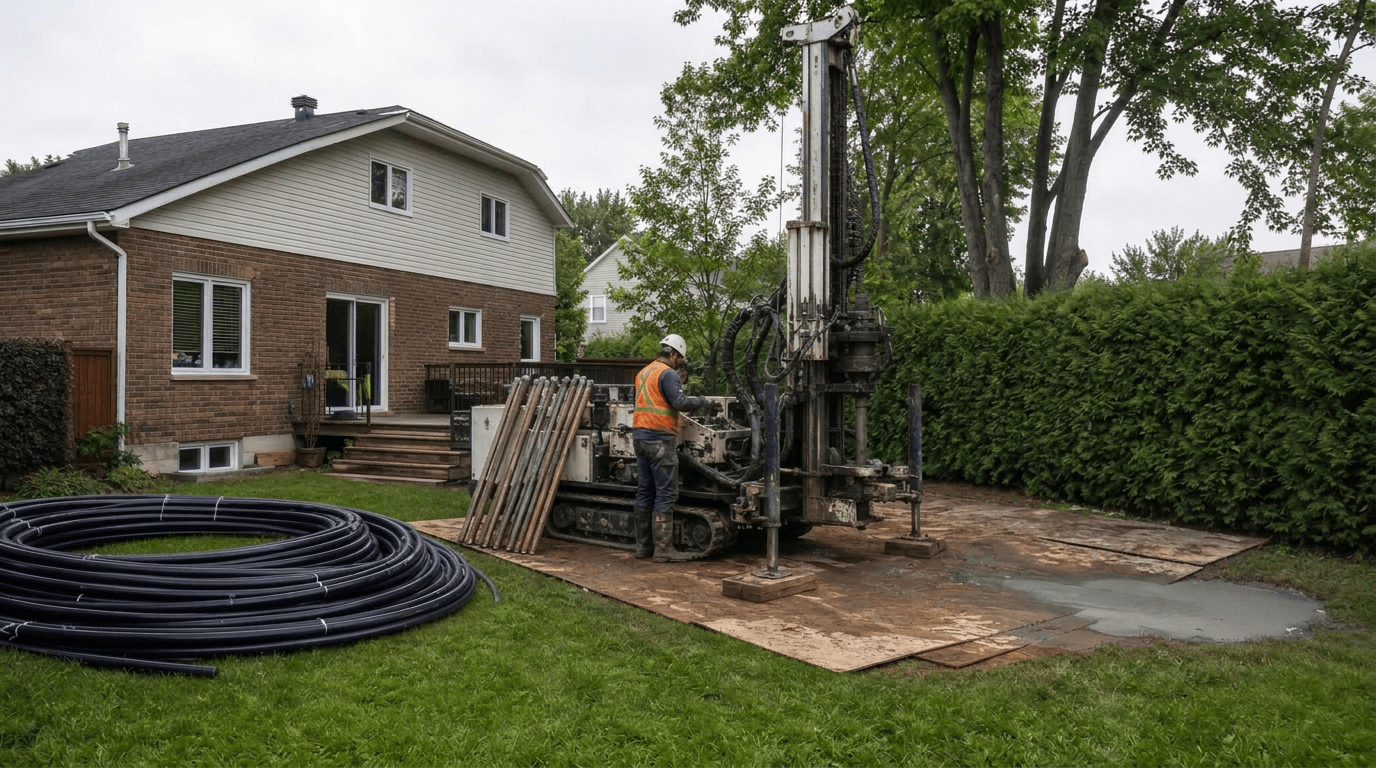
1. Your lot, and what can be drilled on it. The ground loop comes in two layouts. A horizontal loop is buried in trenches and costs the least to install, but it needs a large open yard, since the area required is a multiple of the floor area you are heating. A vertical loop uses boreholes, typically 100 to 150 metres deep, and takes almost no surface, which is why it is the normal answer on a Montreal or Laval lot. What decides it is not just the size of the yard but access: a drill rig has to reach the spot, and the boreholes have to keep their distance from the septic system, the well and the buried services.
2. How the heat will get around the house. The ground loop and the heat pump are only two thirds of the system. The third is distribution. If the house already has ductwork, you are in the shortest and least expensive position, because the new unit can use it. Without ducts, the project also has to create a distribution system, either ductwork or a hydronic loop feeding radiant floors or fan coils. Knowing which case you are in changes the shape of every quote you will receive, so establish it first.
3. The state of the envelope. A geothermal system will work in a poorly insulated house, but the insulation and air sealing decide both how large the equipment has to be and how much it saves once installed. Money spent on the attic and on air sealing often reduces the size of the system you need. A Rénoclimat energy evaluation gives you that picture with a blower-door test and an advisor’s report, and it has to happen before the work starts if you want the grant that goes with it.
4. How long you plan to stay. Geothermal rewards the long hold. The equipment is built for a long service life, the ground loop longer still, and the operating savings accumulate every year you are there. The point at which the savings overtake the investment depends heavily on the house, what it is replacing and what rebates apply, which is why we treat it house by house rather than with a single number. Our article on how profitable a geothermal system is goes through what moves it.
5. Who does the work, and to what standard. Geothermal design and installation in Canada follow CSA standard C448, and accreditation from the Canadian GeoExchange Coalition is the credential to ask about. The drilling is separate work with its own requirements: the driller needs the Régie du bâtiment du Québec licence for water well drilling, and the borehole requires authorization from your municipality under Quebec’s groundwater withdrawal and protection regulation. Ask early who is responsible for obtaining that authorization, because it belongs in the schedule.
6. The rebates, and the order they come in. Geothermal qualifies for support from both Hydro-Québec’s LogisVert program and Rénoclimat, and the amounts are significant enough to change the arithmetic of the project. What catches people out is sequence rather than eligibility: some programs require an evaluation or an approval before the first piece of equipment arrives. Our guide to government HVAC grants in Quebec sets out what is currently available, and our grants and subsidies page covers what we are helping customers claim right now.
What we install. Allard & Emond installs WaterFurnace geothermal systems, including the 3, 5 and 7 Series, and we handle the project from the site assessment through to the rebate paperwork. Like any central system, a geothermal unit is serviced twice a year, once before the heating season and once before the cooling season, and it does both jobs: heating through the winter and air conditioning through the summer.
The fastest way to find out where your property stands is to have someone look at it. Talk to one of our geothermal specialists and we will tell you honestly whether your lot, your house and your plans line up with a geothermal system, and what the alternatives are if they do not.