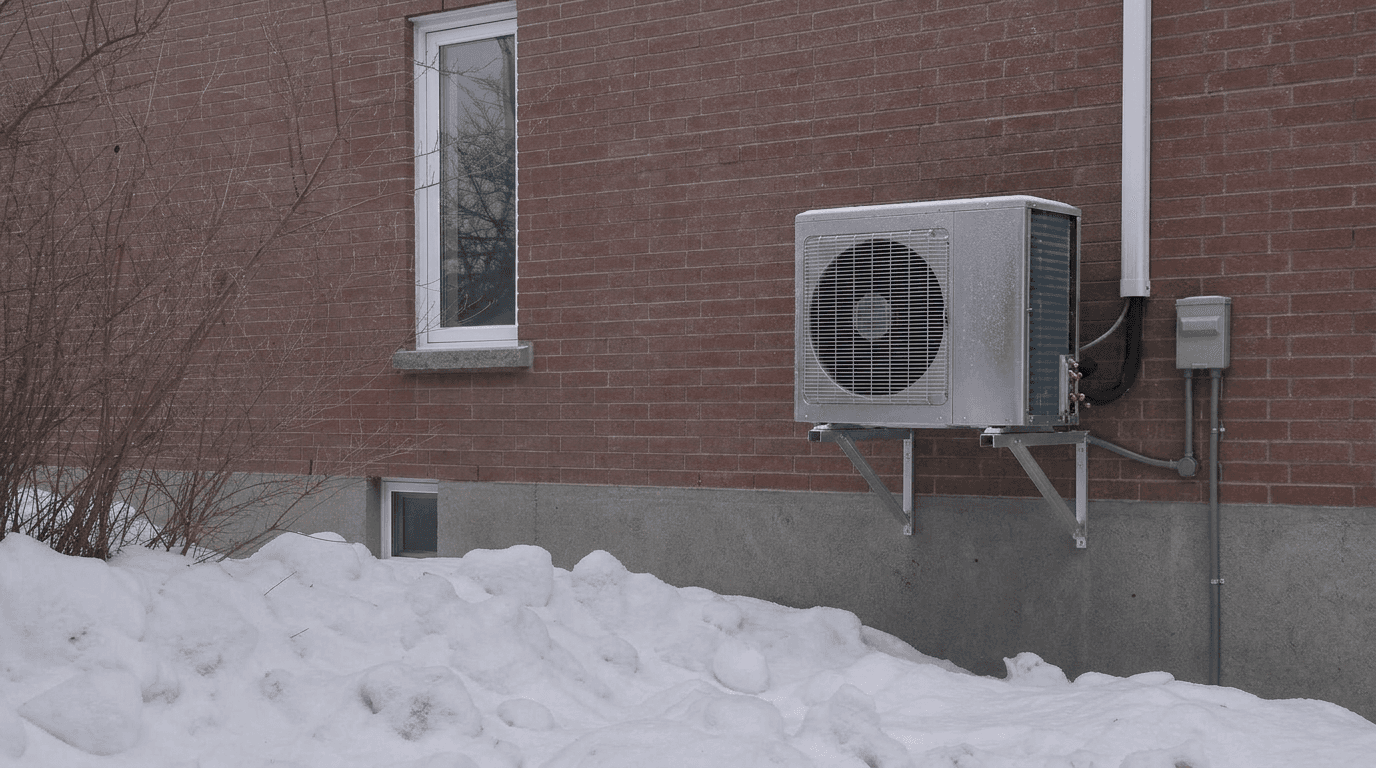
It is the first thing people ask about a central heat pump, and fairly: if it takes its heat from the outside air, what happens when the outside air is −27 °C? The answer is better than the one still circulating, and the number most often quoted back is not what people think it is.
Where the −12 °C figure comes from. You will read everywhere that a heat pump works down to −12 °C and needs help below that. That number is real, but it is not about the equipment. It is the switchover threshold on Hydro-Québec’s Rate DT, the dual-energy billing rate, at which the meter starts charging a much higher price and the house is expected to move to its backup heat. It is a rate structure, not a capability ceiling. Repeating it as a limit tells people the product quits in January, and it does not.
What actually changes as it gets colder. There is genuinely less heat in the air at −25 °C than at 0 °C, so a heat pump does produce less as the temperature falls. What matters is how much less and at what point it stops covering the house on its own. That crossover has a name, the balance point, and it depends on the unit and on the building, not on a single industry-wide number. A cold-climate model sized for this province will still be delivering a large share of its rated capacity at −25 °C. Ask any contractor for that figure specifically, because it is the one that decides your winter, and none of the seasonal ratings show it. Our guide to efficiency ratings explains why.
What runs on the worst nights. Below the balance point the heat pump keeps running and something covers the shortfall. In most Quebec homes that is an electric element in the air handler; in a house with a furnace it is the furnace, alternating with the heat pump in a bi-energy setup that is exactly what Rate DT is designed around. Either way this is normal operation, not a failure, and it is a handful of days a year rather than the whole season. Geothermal avoids the question entirely by drawing on ground that stays near 8 to 10 °C no matter what the air does.
Where Quebec actually is on this. Electricity heats roughly eight homes in ten here, and as of 2025 one household in five now heats primarily with a heat pump. That shift did not happen because of marketing. It happened because the arithmetic is not close: electric resistance heating returns exactly one unit of heat for one unit of electricity and can never do better, while a heat pump returns two to four for the same unit by moving heat rather than making it, which is covered in how a heat pump works.
And it is the same machine in July. This is the part that gets undersold. A central heat pump is also your air conditioning: one outdoor unit, one set of ducts, one thing to maintain, and nothing hanging on a wall. You are not buying a heater and then buying a cooler. You are buying one machine that does both, which is why comparing its price against a furnace alone, or against an air conditioner alone, understates what you are getting.
What it costs to run, and what you can claim. The saving depends on what you are replacing, how well the house holds heat, and how the system is set up, which is why our comparison of heating methods works through it rather than quoting one number. Efficient models also qualify for government rebates, and what is currently available changes from year to year. Once it is in, a few habits and two service visits a year are most of what keeps it performing.
The honest version is that a central heat pump will carry a Quebec winter, with backup on the coldest nights, provided it is a cold-climate model and it is sized to your house. Both of those are decided before installation, not after. Our buyer’s guide covers that purchase, and our advisors will tell you what your home actually needs.